 Minimum Effort
: Office Sim
Corporate Ladder Game for iPhone
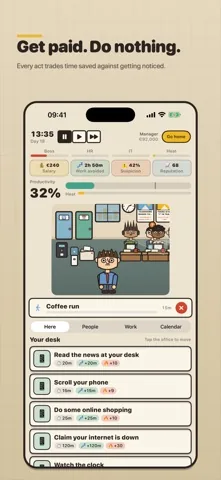
Most career games treat the promotion as the reward. This one prices it. Every rung raises the salary and the daily quota in the same move, so the higher you climb the more work you have to be seen to produce for the same amount of actual effort. Getting promoted is easy. Surviving one rung higher is the game.

Free. Two careers included. iOS 17.0 or later.
The trap
What a promotion actually changes
A rung is four numbers: what it pays, how much work the office expects from you per day, how many days you have to survive at it before anything can happen, and the reputation you need to be moved out of it. Three of those four get harder every time you go up, and the fourth is the one everybody chases.
There is also a ceiling on the whole thing. Above a suspicion of 70 no promotion is possible however good the numbers look, and at 100 the career ends. So the run to the top is not a run at the reputation bar. It is a run at the reputation bar while keeping a second bar down, using the same 480 minutes for both.
Meeting quota pays 6
Clearing the day's expected work adds six reputation. Missing it entirely costs eighteen. The asymmetry is the reason a bad day is expensive and a good day is not cheap.
A clean day pays 4 more
Hitting quota without being caught once takes an extra four points off the suspicion you are carrying. Overnight the boss forgets 2.5 on his own, simply by having other things to think about.
One heroic Tuesday is capped
Delivering beyond the quota buys down suspicion at a quarter of a point per unit, up to ten points and no further. That ceiling is what stops one enormous day laundering a month of fraud.
The free ladders
Corporate and Startup, rung by rung
Both are included in the free download. Corporate is the gentle one: four patrols a day, a floor that gossips at half speed, and a quarterly review nobody reads. Startup is the same ladder with everything turned up: twelve people, no structure, five patrols and the fastest rumour mill in the game.
| Rung | Salary | Daily quota | Days before a move | Reputation needed |
|---|---|---|---|---|
| Junior Associate | 52,000 | 80 | 3 | 58 |
| Specialist | 68,000 | 100 | 4 | 62 |
| Manager | 92,000 | 125 | 5 | 68 |
| Senior Manager | 118,000 | 150 | 6 | 74 |
| Director | 148,000 | 180 | 8 | 100 |
| Rung | Salary | Daily quota | Days before a move | Reputation needed |
|---|---|---|---|---|
| Generalist | 55,000 | 85 | 3 | 60 |
| Product Lead | 78,000 | 115 | 4 | 65 |
| Head of Something | 105,000 | 145 | 5 | 70 |
| VP of Everything | 135,000 | 180 | 6 | 76 |
| Almost a Founder | 175,000 | 220 | 8 | 100 |
Read the salary column and the quota column together. Corporate pays 2.8 times more at the top than at the bottom and asks for 2.25 times the daily output. Startup pays 3.2 times more and asks for 2.6 times the output. Those ratios are the whole argument: the money grows faster than the work, which is why the ladder is worth climbing at all, and slowly enough that every rung is a real decision.
The paid ladders
Consulting and Investment Banking
The Career Pack adds both, with their own colleagues, their own events and their own ways to be found out. Consulting has the softest patrol in the game at three a day and adds a client, who is a fifth person on the floor asking about slide fourteen. Investment banking pays the most money in the game and watches you six times a day.
| Rung | Salary | Daily quota |
|---|---|---|
| Analyst, consulting | 78,000 | 95 |
| Consultant | 105,000 | 125 |
| Engagement Manager | 145,000 | 160 |
| Principal | 200,000 | 195 |
| Partner | 285,000 | 240 |
| Analyst, banking | 98,000 | 110 |
| Associate | 145,000 | 145 |
| Vice President | 215,000 | 185 |
| Director | 320,000 | 225 |
| Managing Director | 480,000 | 275 |
The fifth ladder is the Home Office Pack, which runs from Remote Associate to Head of Distributed Delivery and has no patrol at all, because nobody can see you. It replaces sight lines with telemetry, which turns out to be worse.
Two ladders are in the free download. Start at the bottom of one of them.
The ending
Retire, or be fired
A career can be retired once it has run twenty days and has not ended in a firing. What goes on the record board is the total money earned and the hours you actually worked, and the second number is the one you are optimising. Time spent on genuine work never counts as avoided, which is the point of the score.
Being fired also goes on the board, with the rung you were on when it happened. The board ranks by money rather than by ratio, because a career that never worked a single minute has an infinite ratio and celebrating that would be celebrating being fired on day two.
More about the game